Structure view
slicer provides a structural overview of a class file or the entire workspace. These two views can be toggled at will using the button in the right-top corner of the pane.
The structure view is useful for quickly getting a general idea of a class file’s structure, especially when disassemblers fail to process it correctly.
Workspace
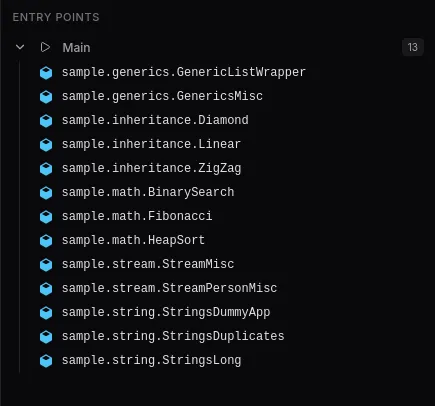
Section titled “Workspace”The workspace structure view displays the size of the workspace and lists classes of interest, such as those containing a main method or similar.
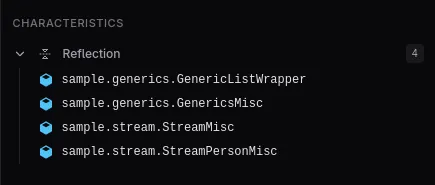
It also shows “characteristics” of the workspace, such as the presence of reflective calls, which can be useful for quickly identifying obfuscated code.
Entry points
Section titled “Entry points”The entry points structure view lists all entry points in the class file, such as those containing the main method, premain method and others:
| Name | Description |
|---|---|
| Main | A class containing a public static void main(String[] args) method. |
| Java agent | A class containing a public static void premain(String[] args[, Instrumentation main]) method. |
| Bukkit plugin | A class extending the org.bukkit.plugin.java.JavaPlugin class. |
| BungeeCord plugin | A class extending the net.md_5.bungee.api.plugin.Plugin class. |
| Velocity plugin | A class annotated with the com.velocitypowered.api.plugin.Plugin annotation. |
| Forge mod | A class annotated with the net.minecraftforge.fml.common.Mod annotation. |
| Fabric mod | A class implementing the net.fabricmc.api.ModInitializer, net.fabricmc.api.ClientModInitializer or net.fabricmc.api.DedicatedServerModInitializer class. |
Characteristics
Section titled “Characteristics”The characteristics structure view lists all characteristics of the workspace, such as the presence of reflective calls, foreign memory access and more:
| Name | Description |
|---|---|
| Class loading | One or more classes use the java.lang.ClassLoader API. |
| Encryption | One or more classes use the javax.crypto.Cipher API. |
| File I/O | One or more classes use the java.io or java.nio.file API. |
| Network I/O | One or more classes use the java.net or java.nio.channels API. |
| Object serialization | One or more classes use the java.io.Object[Input/Output]Stream API. |
| Reflection | One or more classes reference classes from the java.lang.reflect or java.lang.invoke API. |
| FFM/native methods | One or more classes contain native methods or use classes for facilitating foreign memory access, such as java.lang.foreign.MemorySegment and java.lang.foreign.MemoryAddress. |
| Process manipulation | One or more classes use the java.lang.Process(Builder/Handle) or java.lang.Runtime#exec API. |
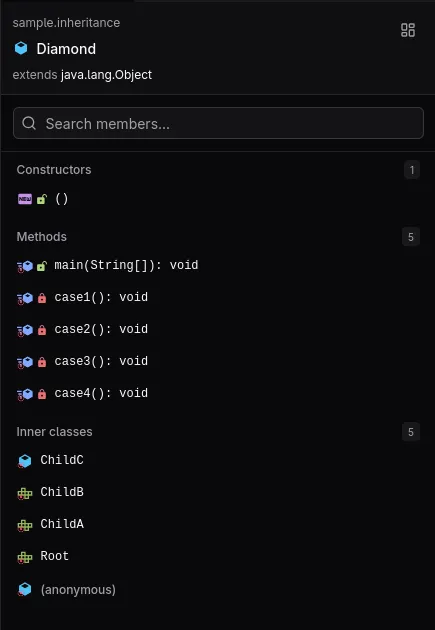
The class structure view lists all members of the class file, such as fields, methods, constructors, initializers and inner classes.
It automatically displays information about the class file open in the primary center position.